Real Hāngī vs Steam Box vs Fusion Feast
Four Rotorua operators advertise a hāngī and use three different cooking methods. What an earth oven really is, how geothermal steam cooking differs, and why it matters.
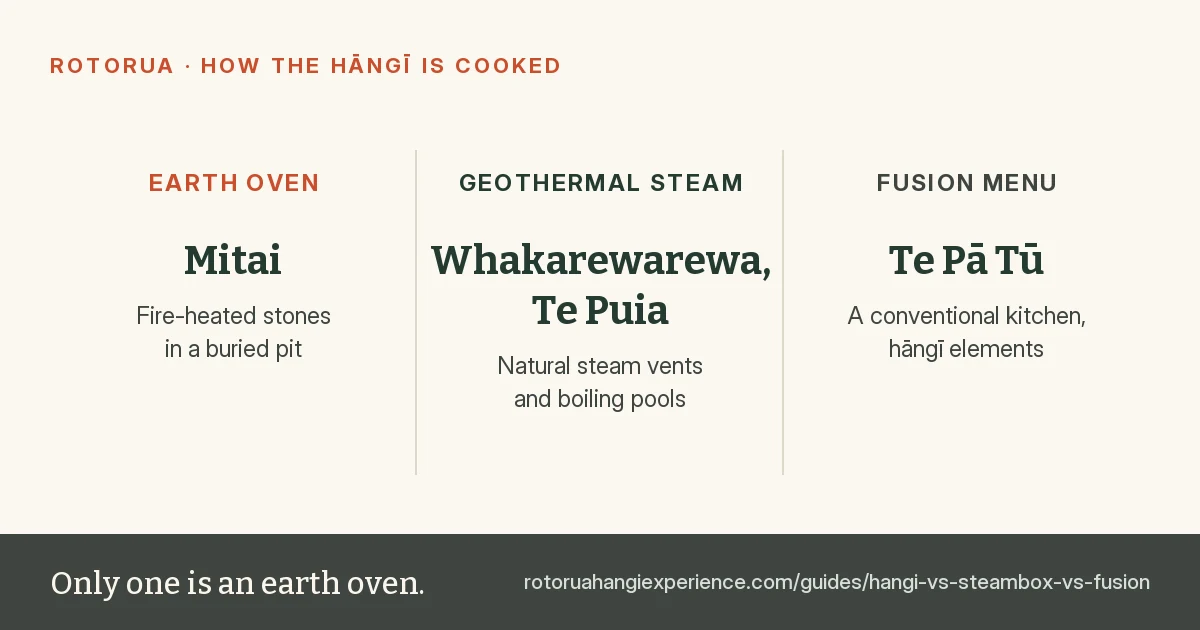
Short answer: four Rotorua operators sell an evening or a meal described as hāngī, and they use three different cooking methods.
Check Availability
- Mitai cooks in a traditional buried earth oven — a pit, fire-heated stones, and food steamed underground.
- Whakarewarewa and Te Puia cook using natural geothermal steam — steam boxes sunk into the ground and boiling mineral pools, with no fire and no pit.
- Te Pā Tū serves a modern fusion menu in which hāngī is one element among chef-designed courses.
All three are legitimate. Only the first is what most visitors picture when they book a hāngī. Here is what each actually involves and how to decide whether the difference matters to you. If you want the method itself explained from scratch, start with what a hāngī is and how the earth oven works.
What an earth-oven hāngī actually is
A hāngī is food cooked in an earth oven. The method is old, physically demanding, and still used across Aotearoa for large gatherings.
How it works:
- Heat the stones. Volcanic or basalt stones are placed in a fire and burned hard for hours. A hāngī guide published by Tūwharetoa Bone describes the fire needing to burn vigorously for a minimum of three to four hours, bringing the stones to roughly 600–700°C, at which point they turn nearly white.
- Prepare the pit. A hole is dug and the glowing stones dropped in. Mitai, the one Rotorua evening operator running a true earth oven, describes its pit as one to two metres deep.
- Layer the kai. Baskets go in with meat closest to the heat and vegetables above — traditionally pork, lamb, chicken, potato, kūmara, pumpkin and cabbage.
- Seal it. Wet cloth and leaves go over the food, then earth is piled on top to trap the heat and steam.
- Wait. Three to four hours for a typical hāngī, up to six for a large one.
The important part: no flame ever touches the food. The sealed pit works like an enormous steam pressure cooker, which is why hāngī meat falls apart and why the food carries a distinct smoky, earthy character that no other method reproduces.
Modern hāngī commonly use mutton cloth, foil and wire baskets in place of woven flax. That is a practical substitution, not a departure from the method.
Geothermal steam cooking: Rotorua’s own tradition
Rotorua sits on an active geothermal field, and the communities living on it have never needed to build a fire to cook.
At Whakarewarewa, home to Tūhourangi Ngāti Wāhiao, residents cook in steam boxes sunk into vents beneath the village and boil food directly in mineral pools. Sweetcorn is cooked in Parekohuru, a large pool whose name is commonly translated as something close to murderous rippling waters, at temperatures around 95°C. Villagers have used this heat to cook, bathe and warm their homes for generations, and still do daily.
Te Puia applies the same principle at visitor scale, cooking its buffet in steam boxes in the Te Whakarewarewa geothermal valley. Its daytime valley tour walks the same ground without the meal.
Is this a real hāngī? This is where people get needlessly snobbish, so it is worth being precise. Geothermal steam cooking is a genuine, place-specific Māori tradition. In Rotorua it is arguably the more deeply rooted practice, because it is tied to this ground and has been part of daily domestic life here for centuries rather than being reserved for special occasions.
What it is not is an earth oven. There is no pit, no fire, no heated stones, and none of the smoke character that comes from them. Calling it a geothermal hāngī is fair. Calling it an earth-oven hāngī is not.
If your mental image is a pit being opened and baskets lifted out, geothermal cooking will not deliver that moment.
The fusion feast
Te Pā Tū takes a third route. It serves indigenous canapés followed by a multi-course menu designed by a celebrated Māori chef, with dishes such as wagyu picanha with watercress chimichurri, taro gratin and kūmara ice cream.
The operator is straightforward about it, describing hāngī as remaining the hero while sharing the table with lesser-known Māori delicacies prepared fusion style.
This is contemporary Māori cuisine rather than traditional preparation. Judged as cooking it is the strongest food in the Rotorua market. Judged as a hāngī it is the furthest from one, which is why it generates a steady flow of surprised reviews — the point we make at length in our Te Pā Tū review.
The hotel buffet
A fourth category exists at the edges: hotel restaurants serving a hāngī buffet, such as the Novotel’s in-house offering in central Rotorua.
One Tripadvisor commenter notes that commercial hotel hāngī are typically cooked in stainless-steel steamers to satisfy New Zealand food-safety regulations, which would mean no earth, no stones and none of the resulting flavour. Treat that as a commenter’s account rather than a confirmed operator statement, but it matches what you would expect from a commercial kitchen.
Convenient, central, and the least traditional of the options.
Compared
| Method | Who uses it | Heat source | Do you see it opened? | Flavour |
|---|---|---|---|---|
| Earth oven | Mitai | Fire-heated stones in a buried pit | Yes, during the evening | Smoky, earthy |
| Geothermal steam | Whakarewarewa, Te Puia | Natural steam vents and boiling pools | Sometimes, on village tours | Clean, steamed |
| Fusion menu | Te Pā Tū | Conventional kitchen, hāngī elements | No | Chef-driven |
| Hotel buffet | Hotel restaurants | Commercial steamers | No | Least distinctive |
Why does Rotorua have both traditions?
Because of a catastrophe.
Māori guiding in Rotorua dates to the 1870s, when visitors came to see the Pink and White Terraces. The eruption of Mount Tarawera in 1886 destroyed the Terraces and buried the village of Te Wairoa, displacing Tūhourangi. Many were taken in by Ngāti Wāhiao at Whakarewarewa, where the geothermal ground offered both shelter and a way to live.
That is how a community came to be permanently settled on a geothermal field, cooking in the vents beneath their homes — and why Rotorua ended up with a cooking tradition found almost nowhere else in the country, alongside the earth oven used everywhere.
Early guides such as Sophia Hinerangi and Maggie Papakura shaped the visitor industry that followed, and the railway reached Rotorua in 1894. The guides working at Whakarewarewa today are descended from them.
Does the method actually matter?
It depends what you came for.
It matters if you want the specific experience of a pit being unearthed, or you want the smoky flavour that only fire-heated stones produce. In that case there is one option in Rotorua and it is Mitai.
It matters less if you want to eat food cooked by the earth in a place where that is ordinary daily life. Whakarewarewa is arguably the more remarkable thing to witness, and at $29 it costs a fraction of an evening show.
It does not matter if you are going for the performance and the food is secondary. All four serve a good meal.
What you should not do is pay the highest price in the market expecting the most traditional meal. The correlation runs the other way.
Full breakdown in best hāngī in Rotorua, every option compared.
A note on spelling
You will see both hangi and hāngī. The macrons mark long vowels and the second spelling is the correct te reo Māori form. Many operators and booking sites drop them, partly for legacy technical reasons. Likewise pōwhiri and pōhiri are both valid, with the variation regional and tribal rather than one being an error.
Frequently asked questions
Which Rotorua operator serves a real earth-oven hāngī?
Mitai Māori Village. It is the only evening operator in Rotorua cooking in a traditional buried pit with fire-heated stones, and it opens the pit in front of guests. Te Puia and Whakarewarewa cook geothermally; Te Pā Tū serves a fusion menu.
How long does a hāngī take to cook?
Three to four hours in the pit for a typical hāngī, and up to around six hours for a large one. Before that, the stones need three to four hours of fire to reach temperature, so the full process runs most of a day.
Is geothermal cooking a real hāngī?
It is a genuine Māori cooking tradition, specific to geothermal areas like Rotorua, and both Whakarewarewa and Te Puia describe the result as hāngī. It is not an earth oven, since there is no pit, fire or heated stones involved.
What food is in a hāngī?
Typically lamb, chicken and pork, with potato, kūmara, pumpkin and cabbage. Rotorua operators generally serve lamb and chicken with vegetables and salads, and dessert alongside. Whakarewarewa adds corn cooked in a boiling mineral pool.
Why does hāngī taste smoky?
Because the food steams in a sealed pit against stones that have been in a fire for hours. No flame touches the food, but the smoke and the hot earth both contribute. Steam-box and commercially steamed versions lack this.
Can you buy hāngī to take away in Rotorua?
The most reliable option is the hāngī pie at Whakarewarewa — the components of a geothermal hāngī meal wrapped in pastry, available in beef, chicken and vegetarian. It is sold at the village, which you enter on the guided village tour.
Details were checked in September 2026. Cooking methods and menus are described as operators present them; confirm specifics with the operator before booking.
See the Hāngī Lifted, Then Sit Down to It
Rotorua's most-reviewed Māori cultural evening — pōwhiri, waka, haka, a hāngī buffet cooked in the ground, and a glow-worm bush walk to finish. Free cancellation up to 24 hours before.
Check Availability & Book