Te Pā Tū vs Mitai: Which Rotorua Hāngī Should You Book?
Te Pā Tū costs about two-thirds more than Mitai for half an hour longer. Here's exactly what the extra buys, and which of the two Rotorua Māori evenings suits you.
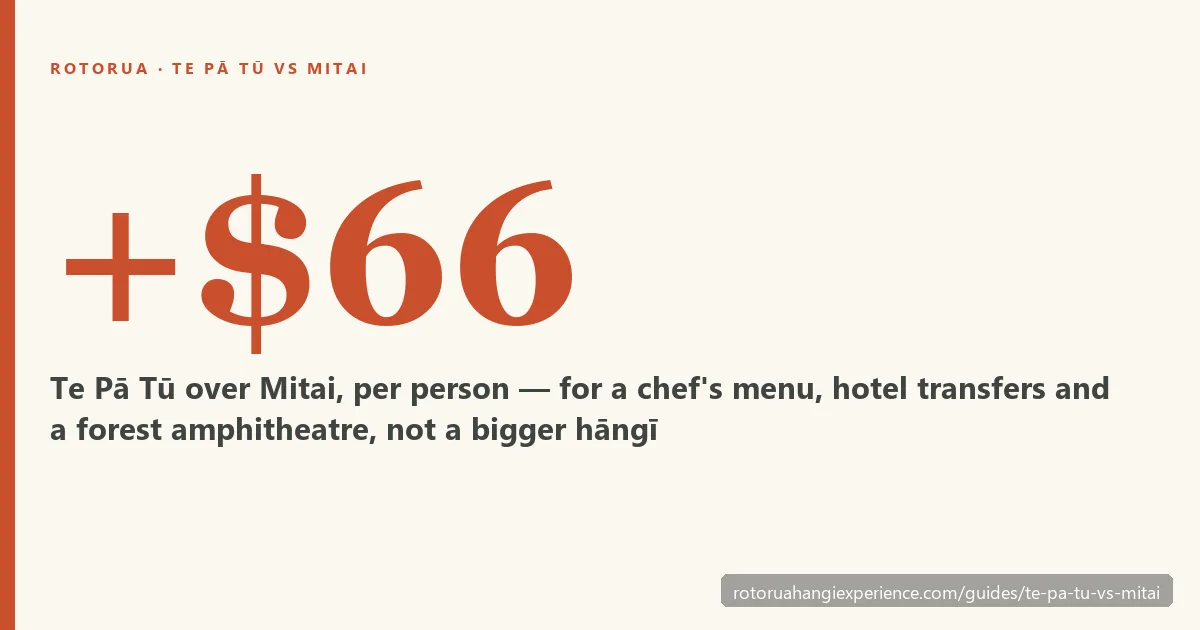
Short answer: book Mitai if you want a traditional hāngī, a full evening’s entertainment and the best value in Rotorua. Book Te Pā Tū if the food is the point of the night, you want a polished production in a forest setting, and you are comfortable paying about two-thirds more for it — $167 against $101 per person on GetYourGuide at the time of writing.
The complication is that these are not really the same product, despite being sold side by side as “Māori cultural evening with dinner”. One serves a buffet lifted out of an earth oven. The other serves a multi-course menu designed by a chef. Once you know that, the price gap stops looking strange.
Check Availability
Why is Te Pā Tū so much more expensive than Mitai?
This is the question that dominates travel forums, usually phrased as: one is a good deal dearer and only about half an hour longer, so what am I paying for?
Four things, roughly in order of how much they matter:
The food is a different category. Mitai serves a buffet: New Zealand lamb and chicken cooked in the pit, vegetables, salads, and a dessert spread. It is generous and it is the real thing. Te Pā Tū serves indigenous canapés followed by a multi-course fusion menu built by a celebrated Māori chef, plated and served family style. Dishes have included wagyu picanha with watercress chimichurri, taro gratin and kūmara ice cream. That kitchen costs money to run.
Transfers are built in. Te Pā Tū’s coach transfer is included for everyone, with hotel pickups typically starting around 5:20pm. Mitai’s transfers are complimentary but optional, and only from selected accommodation, so a portion of its guests self-drive.
The setting is purpose-built. Te Pā Tū runs in a forest amphitheatre among tawa trees with open fires. Mitai’s performance and dining happen in a large marquee-style hall beside the stream.
The programme changes through the year. Te Pā Tū aligns its seasons to the maramataka, the Māori lunar calendar, running a summer harvest season and a winter Matariki season with different content. Mitai runs a consistent format year-round.
What the extra does not buy you is a more traditional meal. If anything, it buys you a less traditional one.
Head to head
| Mitai Māori Village | Te Pā Tū | |
|---|---|---|
| From (GetYourGuide) | $101 | $167 |
| Price position | Best-value evening in Rotorua | Premium, about two-thirds more than Mitai |
| The meal | Buffet hāngī from a buried earth oven | Canapés then multi-course Māori fusion |
| Is it a real hāngī? | Yes, pit-cooked and lifted in front of you | Partly — hāngī features, but it is a fusion menu |
| Length | Around 3 hours | Around 3.5 to 4 hours |
| Transfers | Complimentary but must be requested | Included for all guests |
| Setting | Bush and stream, covered dining hall | Forest amphitheatre, bonfires, al fresco |
| Distinctive extras | Waka on the stream, glowworm bush walk, sacred spring | Seasonal maramataka programme, tā moko and carving demonstrations |
| Drinks | Bar on site, not included | Tea, coffee and water included; bar extra, cashless |
| Vegan | Listings conflict — confirm directly | Stated as not available |
| Tripadvisor (Sept 2026) | 4.4 from around 2,900 reviews | 4.6 from around 6,000 reviews |
| GetYourGuide (Sept 2026) | 4.7 from around 4,100 reviews | 4.8 from around 1,400 reviews |
Prices and inclusions shift seasonally. Confirm on the booking page before you commit.
What you actually do at each
Mitai
The evening opens with a welcome and the selection of a chief from among the guests, then warriors paddle a waka down the Wai-o-Whiro stream in traditional dress. There is a performance of waiata, poi and haka, a tā moko demonstration, and a guided walk into native bush to see the sacred spring and glowworms. The hāngī is unearthed in front of you before the buffet opens.
That walk is the thing people remember. No other Rotorua operator combines a hāngī with glowworms. Our full Mitai review → · Price and inclusions →
Te Pā Tū
You are collected from your hotel or from The Gathering Place on Hinemaru Street in central Rotorua and driven roughly twelve kilometres south. The evening runs as a pōwhiri and warrior challenge, then a village with interactive stations covering weaving, carving and tā moko, then kapa haka in the forest amphitheatre, then dinner, closing with a poroporoaki.
Food arrives across the evening rather than in one sitting: canapés early, the main courses later. It is paced more like a dinner party than a show with a meal attached. Our full breakdown of the Te Pā Tū evening →
The honest downsides
Neither of these is a small, quiet, off-the-beaten-track experience. Both are high-volume operations and both attract “too touristy” comments regularly.
Mitai runs several coach loads most nights. Shared tables with strangers are standard, the hall gets loud, and recent reviews mention salads running low late in service and the food being good rather than great. Its Tripadvisor score of 4.4 as of September 2026 sits noticeably below its 4.7 on GetYourGuide, which is worth knowing before you read only the booking-site reviews.
Te Pā Tū draws the opposite complaint. It is highly choreographed, and some guests find it slick where they wanted intimate. The more specific recurring grievance is from people who booked expecting a classic hāngī and got a fusion tasting menu. Some third-party tickets also carry no cancellation or reschedule rights, so check the terms on whichever platform you use — the GetYourGuide listing offers free cancellation up to 24 hours before.
Which one is right for you?
Book Mitai if:
- You want an actual earth-oven hāngī, lifted in front of you
- You are travelling on any kind of budget
- You have children, or a group where a buffet suits everyone
- Glowworms and the waka appeal
- You are happy to self-drive, or you remember to request transfers
Book Te Pā Tū if:
- Food is the reason you are going out
- You are marking an occasion
- You want transport handled with no extra step
- The idea of a forest amphitheatre and bonfires sells it
- You already know it is a fusion menu and want that
Book neither if: you want something small-scale and unhurried. In that case, look at a daytime visit to Whakarewarewa, the living village, which is neither a show nor a buffet.
Check availability and prices for Mitai → Check availability and prices for Te Pā Tū →Can you do both?
Yes, and a few people do across a longer Rotorua stay, but there is heavy overlap. Both include a pōwhiri, a haka, poi and a performance. If you have two evenings, a better pairing is Mitai for the hāngī and Te Puia’s Te Pō for the geysers at night, since Te Puia adds geothermal attractions that neither of these two cover. (Our breakdown of Te Pō →)
Frequently asked questions
Is Te Pā Tū the same as Tamaki Māori Village?
Yes. Tamaki Māori Village was bought by Tauhara North No. 2 Trust in November 2018 and relaunched under the name Te Pā Tū around May 2022. Booking platforms still carry the old name in some URLs, and older reviews sit under it. It is still open, on the same forest site.
Which has better food, Mitai or Te Pā Tū?
Te Pā Tū, by most accounts, if you are judging on cooking. Its menu is chef-designed and served in courses. Mitai’s is a buffet, praised more for authenticity and quantity than refinement. But Mitai’s food is the traditional one: if “better” means a real hāngī, Mitai wins by definition.
Which is better for families with children?
Mitai, generally. It is shorter at around three hours, the buffet suits fussy eaters, and the waka and glowworms hold children’s attention. Te Pā Tū is also family-friendly and offers child pricing for ages five to fifteen with under-fours free, but it runs longer and the food is less familiar.
Does Mitai or Te Pā Tū include hotel pickup?
Te Pā Tū includes return coach transfers for all guests. Mitai offers complimentary transfers from selected Rotorua accommodation, but you must request this when booking rather than on the night. We cover every operator’s pickup arrangements in our guide to hāngī experiences with hotel pickup.
Can I get a vegan meal at either?
Te Pā Tū states it cannot cater for vegans. Mitai’s own listings contradict each other on the point, with one saying vegan options are available and its GetYourGuide listing saying they are not. Contact Mitai directly rather than relying on a booking platform. Both handle vegetarian, and Te Pā Tū caters gluten-free, though not from a coeliac-certified kitchen. See our guide to dietary requirements at a Rotorua hāngī.
How far in advance should I book?
At least a week in peak season, which runs roughly December to February and across New Zealand school holidays. Te Pā Tū is the more commonly recommended advance booking of the two. Same-day availability in summer is unlikely for either.
Which one is more authentic?
Both are Māori-owned and Māori-run, so neither is a performance by outsiders. On the food, Mitai is the traditional one. On the wider programme, they are comparable, and the more useful question is which format you want rather than which is more real. We unpack the cooking methods in our guide to real hāngī vs steam box vs fusion feast, and in what a hāngī actually is.
Details were checked in September 2026 and change seasonally. Confirm prices, start times and dietary policies with the operator before booking.
See the Hāngī Lifted, Then Sit Down to It
Rotorua's most-reviewed Māori cultural evening — pōwhiri, waka, haka, a hāngī buffet cooked in the ground, and a glow-worm bush walk to finish. Free cancellation up to 24 hours before.
Check Availability & Book