What Is a Hāngī? How the Māori Earth Oven Works
A hāngī is food steamed underground on fire-heated stones. How the pit is built, what goes in it, how it tastes, and where in Rotorua you can still watch one lifted.
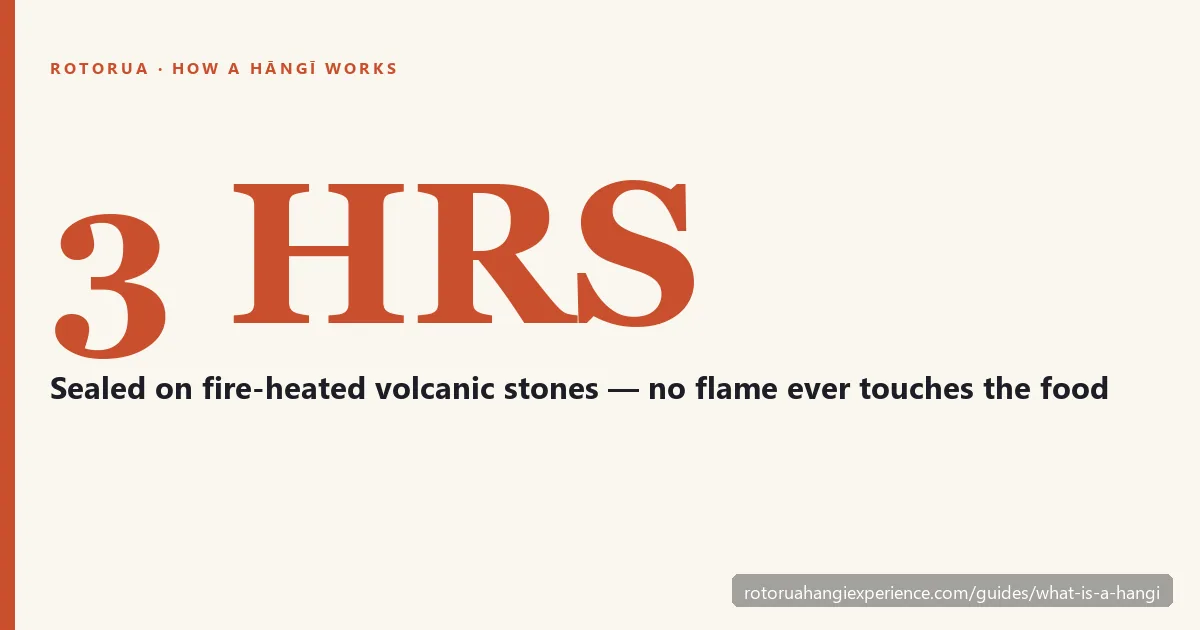
A hāngī is a Māori method of cooking food in a pit, using volcanic stones heated in a fire until they glow. Baskets of meat and root vegetables are lowered onto the hot rock, covered with wet cloth and sacking, and buried under earth for around three hours. What comes out has been steamed under pressure in its own moisture — meat that pulls apart with a fork, vegetables that taste faintly of smoke and soil. The word describes both the oven and the meal that comes out of it.
In Rotorua, the same principle is applied without the fire: the ground here is already hot, so the town’s Māori communities have cooked in geothermal steam for generations.
Check Availability
How a hāngī is built, step by step
1. Dig the pit. A shallow rectangular hole, sized to the amount of food and typically knee-deep. Too deep and the heat cannot circulate; too shallow and the steam escapes.
2. Heat the stones. Volcanic river stones go into a fire built in the pit and burn for a couple of hours until they are glowing. The rock matters — porous volcanic stone holds heat and, crucially, does not shatter when water hits it. This is the step that cannot be rushed and the one that decides whether the meal works.
3. Rake out the embers. The burnt wood comes out; the hot stones stay. What cooks the food from here is stored heat, not flame.
4. Load the baskets. Wire or woven baskets are laid on the stones, traditionally bedded on green leaves — watercress and cabbage leaves are common — which protect the food and add moisture. Meat goes on the bottom where it is hottest: pork, lamb, chicken, sometimes mutton birds. Root vegetables go above: potatoes, kūmara (sweet potato), pumpkin, carrots. Stuffing and puddings sit on top.
5. Wet it down and seal it. Water is thrown onto the stones to flash into steam, then wet cloth, sacking and finally earth go over the whole pit. The seal is the whole trick — a hāngī that leaks steam cooks unevenly.
6. Wait about three hours. Nothing to watch, nothing to adjust. Then the earth comes off and the baskets come up in a column of steam. That lifting is the moment worth turning up for.
What a hāngī actually tastes like
Not smoky in the barbecue sense. The dominant note is a clean, faintly mineral steam flavour that permeates everything in the pit equally — the pork tastes a little of kūmara and the kūmara tastes a little of pork. Meat is exceptionally tender because it has been held at a moderate temperature in a saturated atmosphere for hours, which is closer to sous vide than to roasting.
Two things surprise first-timers. There is no crisp skin or char anywhere — a hāngī steams, it does not brown. And the seasoning is restrained: the method is the flavour, so heavy spicing would be beside the point.
Hāngī, umu, lovo and imu — the same idea across the Pacific
Earth-oven cooking is Polynesian, not uniquely Māori. The hāngī has close relatives across the region: umu in Samoa and much of western Polynesia, where the stones are more often built above ground; lovo in Fiji; imu in Hawaiʻi, best known as the method for kālua pig. The engineering is the same — fire-heated stone, a sealed chamber, slow steam — and the differences are in the pit’s construction, the leaves used for wrapping, and what goes in it.
If you have eaten kālua pork at a Hawaiian lūʻau, you have eaten the same technique under a different name.
The Rotorua difference: cooking without a fire
Rotorua sits on the Taupō Volcanic Zone, and in places the heat reaches the surface as steam vents and boiling pools. At Whakarewarewa, the living village at the southern edge of town, that heat is domestic infrastructure. Residents cook in steam boxes built over vents, boil food in the hot pools, and bathe in thermal water — as their families have for generations. The guided village hour walks you past all of it, and the ticket includes a corn cob cooked in a geothermal pool.
It is not strictly a hāngī, because no fire and no buried stones are involved. It is the same result reached by a shortcut the geology provides, and it is the reason Rotorua rather than anywhere else became the place visitors associate with earth-cooked Māori food.
Where you can still watch a hāngī lifted in Rotorua
Only one commercial evening makes the uncovering of the pit a scheduled event in front of guests: Mitai Māori Village. Steam rolls off the baskets as they come out; dinner follows straight after. Our breakdown of that evening →
Te Puia’s Te Pō serves a traditionally cooked hāngī buffet at its restaurant above the thermal valley — the food is the real thing, but you do not see it prepared. Te Pā Tū serves a four-course menu by its own chefs that draws on hāngī technique rather than reproducing it.
If the pit itself is what you came for, that distinction is the whole decision. Our comparison guide sets every option side by side.
Frequently asked questions
What does hāngī mean?
It refers both to the earth oven itself and to the meal cooked in it. In everyday New Zealand use, “having a hāngī” means the gathering as much as the food — it is a method that only makes sense at scale, for a crowd.
How long does a hāngī take to cook?
Roughly three hours in the pit, after one to two hours spent heating the stones. Preparing a hāngī properly is close to a half-day’s work, which is why it is reserved for occasions.
What food goes in a hāngī?
Pork, lamb, chicken and sometimes mutton bird for the meat; potato, kūmara, pumpkin and carrot for the vegetables; often stuffing and a steamed pudding. Seafood appears in coastal variations. Green leaves such as watercress or cabbage line the baskets.
Is hāngī food smoked?
No. The embers are raked out before the food goes in, so the food never meets flame or smoke directly. The flavour is steam-borne and mineral rather than smoky, and nothing in a hāngī browns or crisps.
Can you eat hāngī if you are vegetarian?
With difficulty. Everything in the pit shares the same steam, so vegetables cooked above meat carry its flavour, and most operators cook a single communal oven. Some Rotorua venues prepare separate vegetarian portions with notice — see our dietary and accessibility guide for who can do what.
What is the difference between a hāngī and an umu?
They are regional variants of the same Polynesian earth-oven technique. A hāngī is Māori and generally cooked in a dug pit; a Samoan umu is more often built up on stones above ground. Fiji’s lovo and Hawaiʻi’s imu are further relatives of the same method.
See the Hāngī Lifted, Then Sit Down to It
Rotorua's most-reviewed Māori cultural evening — pōwhiri, waka, haka, a hāngī buffet cooked in the ground, and a glow-worm bush walk to finish. Free cancellation up to 24 hours before.
Check Availability & Book